
 In your quote
In compare
Trapezoidal Spirit Levels
20 products
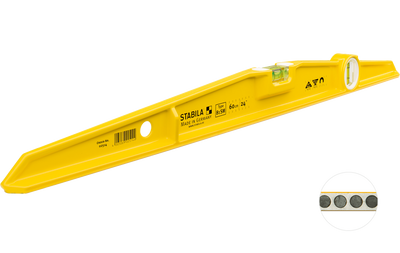
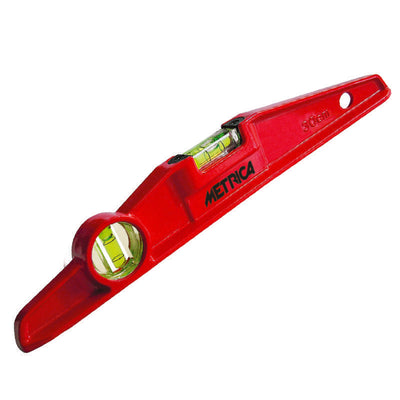
Trapezoid levels have a body that tapers towards the ends: they are light and easy to handle and are used mainly in masonry work to check the laying of bricks, blocks and alignments. The collection includes Stanley models from the FatMax MLH series, also with magnetic inserts.
Types included
- FatMax MLH levels in various lengths;
- magnetic versions, to cling to steel sections and structures;
- models with vials for horizontal and vertical measurements.
How to choose
Choose the length according to the spans to be checked: the longer the level, the more reliable it is on extended surfaces. The magnet is useful if you work on steel, while the end protection helps preserve accuracy over time.
The tapered shape makes the level lighter to hold all day, an advantage in masonry work where the laying plane is checked often. With magnetic inserts it can also be placed against formwork and metal sections.
For availability and terms, request a quote from AMES Srl.
Active filters:
Products in this collection
In your quote
In compare
 In your quote
In compare
 In your quote
In compare
 In your quote
In compare
 In your quote
In compare
 In your quote
In compare
 In your quote
In compare
 In your quote
In compare
 In your quote
In compare
 In your quote
In compare
 In your quote
In compare
 In your quote
In compare
 In your quote
In compare
 In your quote
In compare
 In your quote
In compare
 In your quote
In compare
 In your quote
In compare
 In your quote
In compare
 In your quote
In compare
 In your quote
In compare
Frequently asked questions: Trapezoidal Spirit Levels
What are trapezoid spirit levels used for?
Trapezoid spirit levels have a body that tapers towards the ends: they are light and easy to handle. They are used mainly in masonry to check the laying of bricks, blocks and alignments, and in general to check that a surface is level or plumb, where a quick reading is needed.
Magnetic or standard spirit level: when should I choose the magnetic one?
The magnetic spirit level clings to iron profiles and structures, such as studs, beams or sheet metal, and leaves your hands free while measuring. The standard version is fine on wood, masonry or plaster surfaces, where the magnet is not needed. Choose the magnetic one when working on metal, so you do not have to hold the level by hand.
What length of spirit level should I choose for bricklaying?
Choose the length according to the span to be checked: the longer the level, the more reliable it is on extended surfaces, because a small error in positioning has less effect on the result. For small jobs short lengths are enough, while for courses and long alignments a longer level is better. FatMax MLH levels are available in several lengths.
What are horizontal and vertical vials used for?
Horizontal vials are used to check level, vertical ones to check plumb, that is, the vertical alignment of walls, studs or pillars. Some models have both, so horizontal and vertical can be checked with the same level. Before using it, check that the vials are firmly fixed and that the level is clean, because dirt affects the reading.
How do you check a trapezoid spirit level before using it?
Place the level on a flat surface, read the bubble, then turn it through 180 degrees along the same line and read it again. If the bubble is in the same position, the level is accurate; if it changes, it needs adjusting or replacing. Also check that the bearing edges are not dented, because dents falsify the measurement.
Stanley, Metrica or Stabila spirit levels: which should I choose?
In the catalogue the trapezoid spirit levels are from Stanley, with the FatMax MLH series and twin-base models, from Metrica, with die-cast versions with a magnetic or standard base, and from Stabila, with models 81 S and 81 SM. Choose according to the material you work on, whether you need a magnet and the length you need, rather than the brand.
When do I need a trapezoid spirit level instead of a traditional one?
The trapezoid spirit level is useful when the surface is narrow, such as the bed for laying bricks or blocks, where a larger level does not sit well. The slim shape lets you work in tight spaces without getting in the way. For checks on long walls or large surfaces, a longer, sturdier level is better.