
 In your quote
In compare
Rivets
26 products
Rivets are permanent fasteners: they are inserted into a through hole and deformed with the riveting tool, joining sheet metal, sections and panels without welding or screwing. They are used in light fabrication, window and door frames, sheet metal work and maintenance.
Types of rivets included
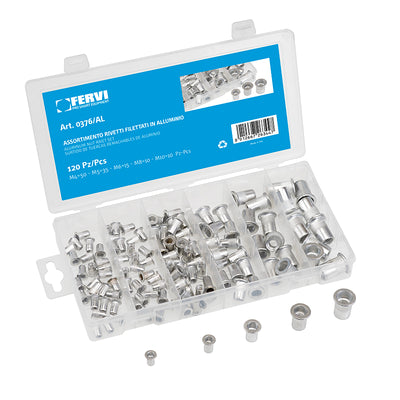
- Aluminium blind rivets, with standard or extra-large head.
- Steel, stainless steel and copper rivets, for different materials and environments.
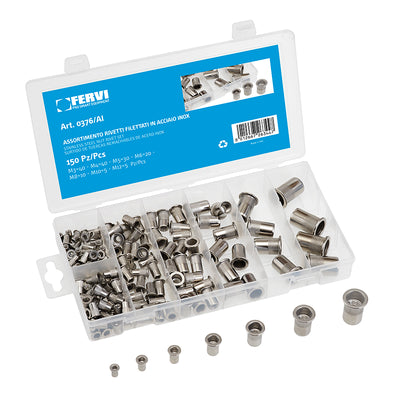
- Threaded rivets, also sold in steel and stainless steel assortments.
- Special rivets, such as petal rivets.
The brands included are Bossong, Fervi, Fischer and Vigor, as well as A.M.E.S. products.
How to choose
You need the diameter and length of the rivet, chosen according to the total thickness to be clamped, and the material: it is best to match the rivet to the material being fastened to avoid corrosion between different metals. Threaded rivets require the dedicated tool.
For quantities, sizes and delivery times, request a quote from AMES Srl.
Active filters:
Products in this collection
In your quote
In compare
 In your quote
In compare
 In your quote
In compare
 In your quote
In compare
 In your quote
In compare
 In your quote
In compare
 In your quote
In compare
 In your quote
In compare
 In your quote
In compare
 In your quote
In compare
 In your quote
In compare
 In your quote
In compare
 In your quote
In compare
 In your quote
In compare
 In your quote
In compare
 In your quote
In compare
 In your quote
In compare
 In your quote
In compare
 In your quote
In compare
 In your quote
In compare
 In your quote
In compare
 In your quote
In compare
 In your quote
In compare
 In your quote
In compare
Frequently asked questions: Rivets
What are rivets used for and where are they used?
Rivets are permanent fasteners: they are inserted into a through hole and deformed with a riveter, joining sheet metal, profiles and panels without welding or screwing. They are used in light metalwork, window and door frames, sheet-metal work and maintenance, where welding is not necessary or not possible.
Aluminium, steel or stainless steel rivet: how do I choose?
Aluminium is light and easy to deform with the riveter, ideal for thin sheet metal and sheet-metal work. Steel is stronger and holds heavier loads. Stainless steel is chosen where there is moisture or contact with aggressive agents, while copper is chosen for specific materials and environments. The rivet material should be compatible with the material being joined.
What is the difference between a blind (pop) rivet and a threaded rivet?
A blind rivet is deformed with the riveter and is used on thin sheet metal and profiles, with access from one side of the piece only. A threaded rivet has an internal thread and is used to fix a screw, useful when you need to dismantle and reassemble the part several times without losing the fixing.
What rivet diameter and length should I choose?
The diameter and length of the rivet are chosen according to the thickness of the sheets to be joined and the hole you already have. The shank must protrude just enough to form the head, without excess. The datasheets give the sizes, such as 3 x 6 mm, to compare with the material thickness before you start.
Who uses rivets and for what jobs?
Rivets are used by sheet-metal workers, window fitters, light metalworkers, sign installers and plant maintenance staff. They are used to fix sheet metal, panels, aluminium profiles and hinges, where a quick, permanent fixing is more practical than welding or a screw.
How do I use a riveter correctly?
Insert the rivet into the nose of the tool, then push the shank into the hole until the head rests on the material. Squeeze the lever with firm, steady strokes until the shank breaks off and forms the second head. Check that the rivet is firmly fixed and that the material has not deformed around it.
How do I remove a faulty rivet without enlarging the hole?
To remove a blind rivet, drill out the head with a bit of the right diameter, then extract the body. Use a bit at low speed and without excessive pressure, so as not to enlarge the hole. An enlarged hole needs a larger-diameter rivet, so always check the original size first.